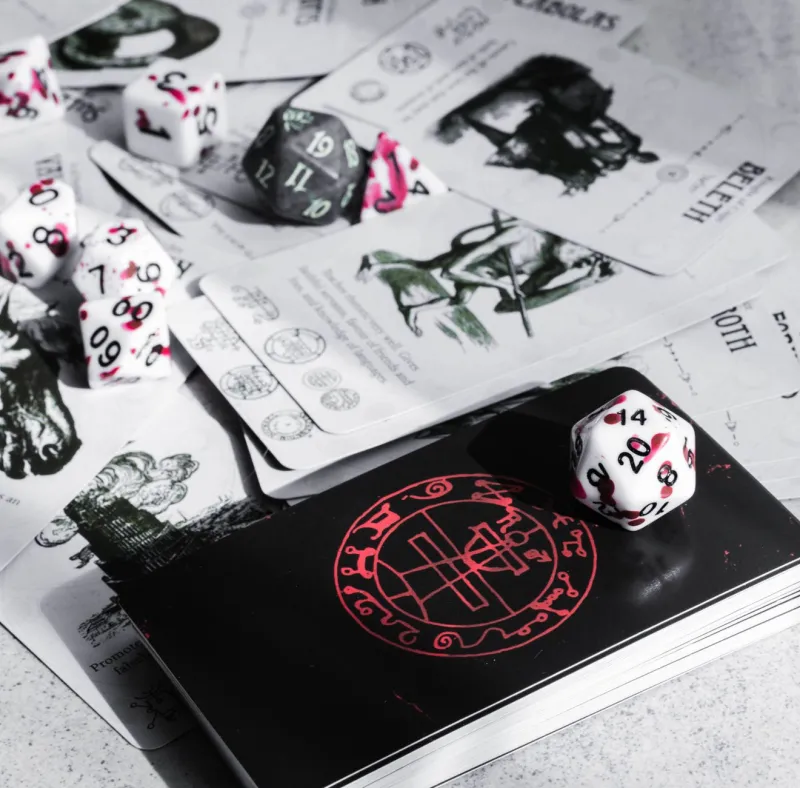
Stop Chasing the Meta: How Optimization Culture Is Stealing Your Character's Soul

There's a moment most tabletop players know intimately. You've got a character concept burning in your brain — maybe a pacifist warlock who refuses to use Eldritch Blast on principle, or a fighter who dual-wields hand crossbows purely because it fits the roguish mercenary vibe you're going for. You're excited. You open a browser tab to start building.
And then the guides find you.
Within ten minutes, you're three Reddit threads deep, someone has explained why your concept is "trap choices all the way down," and suddenly you're staring at a Paladin/Sorcerer multiclass you never wanted, optimized to a razor's edge, completely divorced from the character you actually wanted to play.
Welcome to the tyranny of the meta.
The Algorithm of the 'Correct' Build
Optimization culture didn't appear out of nowhere. It grew organically from a genuine love of the game's mechanical systems — and honestly, there's nothing wrong with enjoying the math. Figuring out how Sharpshooter interacts with Archery Fighting Style, or how a Twilight Cleric's Channel Divinity stacks with certain party compositions, is genuinely fun puzzle-solving. The problem isn't that optimization exists. The problem is when it becomes the only lens people use to evaluate a character.
Psychologists have a term for this: the "correct answer" effect. When people believe there's a definitively right choice available, the pressure to select it becomes almost compulsive. In gaming, tier lists and optimization guides manufacture that sense of correctness. Suddenly, playing a Beastmaster Ranger isn't just a stylistic preference — it's a mistake that needs correcting. Your DM might not say anything, but the internet certainly will.
Veteran player Marcus T., who's been running games out of his garage in Austin since the 3.5 edition days, put it plainly: "I watched my whole friend group shift over about two years. We used to show up with weird characters — a monk who was secretly a failed wizard, a barbarian who was terrified of blood. Now everyone shows up with a build they found on YouTube. The characters all feel like they were assembled, not created."
When the Spreadsheet Becomes the Character Sheet
Here's the quiet damage optimization culture does to a campaign: it narrows the possibility space of who your character is. When every choice is filtered through "does this make me more effective in combat," the mechanical tail starts wagging the narrative dog. Your character's background, their fears, their weird personal quirks — these things stop mattering because they don't translate into stat blocks.
And that's a loss. Not a minor inconvenience — an actual loss of what makes pen-and-paper RPGs irreplaceable in a world full of video games that can simulate combat far more efficiently.
Sarah R., a longtime player and occasional DM from Chicago, described the shift in her own approach after years of chasing optimal builds: "I spent two whole campaigns playing characters I didn't actually care about because they were mechanically solid. Then I played a half-orc Life Cleric who was supposed to be a terrible choice for my party composition, and she became the most memorable character I've ever run. Because I had to think about her. I had to justify her existence in the story, not just in the math."
That justification — that narrative labor — is exactly what gets skipped when you follow a guide.
The Counterintuitive Joy of Intentional Suboptimality
Here's a reframe worth sitting with: a "suboptimal" build isn't a failed build. It's a character with constraints. And constraints, in storytelling, are generative. They force creativity. They create stakes.
A Paladin who took the wrong subclass because it fit their oath's flavor has to work harder in certain encounters — and that struggle becomes story. A wizard who dumped Constitution because their character is genuinely physically frail has to be clever, has to rely on the party, has to be scared sometimes. That's not a mechanical failure. That's roleplay fuel.
Some of the most beloved characters in actual play history — and plenty of legendary characters at kitchen tables across America — weren't built to be efficient. They were built to be interesting. Those are different goals, and it's worth being honest with yourself about which one you're actually chasing.
Reclaiming the Character Concept
None of this means you have to ignore mechanics entirely. Knowing the rules well enough to make informed choices is different from letting tier lists make those choices for you. The goal isn't ignorance — it's intentionality.
A few practical approaches that veteran players swear by:
Start with a sentence, not a subclass. Before you open any guide, write one sentence about who your character is as a person. "A disgraced knight trying to earn back their honor" or "a street kid who taught themselves magic from stolen books." Let that sentence drive your mechanical choices, not the other way around.
Give yourself one 'wrong' choice on purpose. Pick one feat, spell, or ability that serves your character's story rather than their combat efficiency. Notice how it changes the way you engage with the game.
Ignore the comment sections. Seriously. Build in private, at least for your first pass. The optimization discourse will always be there. Your initial creative instinct won't.
Talk to your DM. A good Dungeon Master will build encounters and moments that make your specific character shine — but only if they know who your character actually is. The more story you bring to the table, the more story you'll get back.
The Parchment Doesn't Lie
At the end of the day, your character sheet is a document about a person — or at least, it should be. The numbers matter, sure. But the parchment is also where you write down your character's name, their god, their dead brother, the scar they got in a city they can never go back to.
No optimization guide covers that stuff. And that stuff is the whole point.
The meta will shift with every new sourcebook. Characters built to chase it will feel dated and hollow in a year. But the half-orc cleric, the cowardly fighter, the warlock who hates their patron — those characters stick around in the stories you tell afterward. They're the ones people remember.
Play the character you actually want to play. The dice don't care about your damage output. Your table does.